
GEO for Multi-Location Brands: Why Your Franchise Is Invisible in AI Search (And How to Fix It)
AI search doesn't care about your brand's national authority — it evaluates each location as a separate entity. Most franchise brands are invisible at the location level in ChatGPT and Perplexity. This guide covers the 4 reasons why and the exact per-location GEO playbook to fix it.
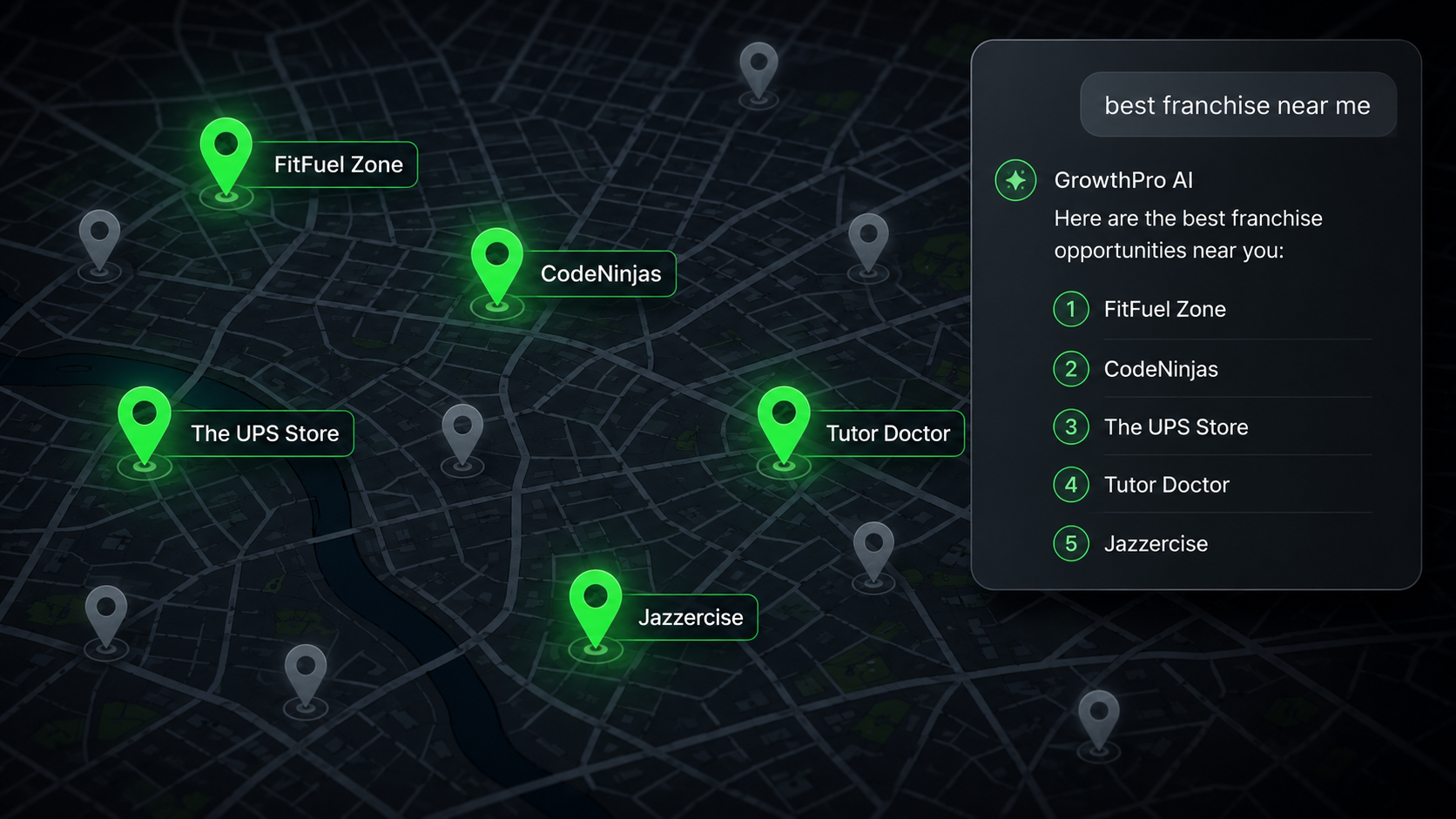
Traditional SEO for multi-location brands is largely a brand-level exercise: a strong domain, consistent category keywords, a well-structured sitemap, and location pages. Google's algorithm handles the rest via proximity signals.
AI search doesn't work this way.
When ChatGPT or Perplexity recommends a business, it synthesizes entity data — structured information about who the business is, what it does, where it operates, and how authoritative it appears across the web. For a franchise with 30 locations, each location needs its own entity signal stack. The brand's domain authority doesn't transfer automatically to each individual storefront.
A customer asking "best financial advisor in Austin" is not asking about your national brand. They're asking about a local entity. If your Austin location has inconsistent listings, thin reviews, or no location-specific content, AI models will skip it — even if your national brand is well-recognized.
This is the core GEO problem for multi-location brands: you have a brand presence, but 80% of your locations have no AI-recognizable local identity.
Issue 1: Per-Location Entity Inconsistency
AI models build trust in a business by cross-referencing its presence across multiple sources: the website, Google Business Profile, Yelp, Facebook, industry directories, and third-party mentions. When those sources conflict, confidence drops.
For a single-location business, maintaining consistency across 10–15 platforms is manageable. For a 50-location franchise, it's a compounding problem. A location that opened with one phone number and address, changed its hours, moved suites, and had a manager update the GBP without updating the website now has conflicting entity data across a dozen platforms — and AI models treating it as an unreliable source.
What inconsistency looks like at scale:
- Location A lists "Suite 200" on the website but "Suite 2B" on Google
- Location B uses the brand's national phone number rather than a local line
- Location C's Yelp page still lists the previous manager's name
- Half your locations are missing from key industry directories entirely
The fix: Audit every location's NAP (name, address, phone) data across your top 10 citation sources. Prioritize Google Business Profile, Yelp, Facebook, Apple Maps, and any vertical-specific directories for your industry. Every field must match exactly — not approximately. AI models parse these signals literally.
Want this done for you?
Get a free GEO & AI visibility audit — we show exactly where your business is missing from Google and AI answers.
Get Free Audit →Issue 2: Review Volume Is Pooled at the Brand Level, Not the Location Level
Review signals for AI search don't aggregate across locations. A franchise with 500 five-star reviews across all its locations does not have 500 reviews from the perspective of an AI model evaluating your Chicago location specifically. That location has whatever reviews it has earned individually — and if that's 8 reviews from 2022, it looks like a low-authority, inactive business.
AI models prioritize:
- Volume — 50+ reviews signals an established, trusted location
- Recency — Reviews in the past 90 days signal active operations
- Specificity — Reviews that mention the specific service, staff member, or location
- Response rate — Locations that respond to reviews within 48 hours signal active management
For multi-location brands, review velocity tends to be uneven: flagship locations accumulate reviews naturally, while newer or lower-traffic locations go months without a single new review. This creates a two-tier AI search presence — some locations well-represented, others completely invisible.
The fix: Implement a location-level review request workflow, not a brand-level one. Every customer interaction at every location should trigger a review request tied to that specific location's Google Business Profile link. The goal is consistent review velocity across all locations, not a strong average obscuring weak outliers.
Issue 3: No Location-Specific Content or FAQ Signals
AI models rely heavily on content — specifically, content that answers the questions real customers ask before making a decision. For a multi-location brand, this content almost never exists at the location level.
What most multi-location websites look like: a national homepage, a "locations" page with a list or map, and individual location pages that contain only the address, hours, and phone number.
What AI models need to recommend a specific location: content that answers the questions a potential customer in that market would ask. Not just "where is the nearest location" — but "what services does the [City] location offer?", "does this location have parking?", "is this location open on Sundays?", "what do customers say about this location specifically?"
FAQPage schema at the location level is one of the highest-ROI GEO signals available for multi-location brands. Most chains have zero location-level FAQ schema. Their competitors with even basic location-specific FAQ content will be cited more often by AI models for local queries.
The fix: Add a minimum of 5 location-specific FAQ items to each location page. These don't need to be unique to every location — a template covering services, hours, parking, appointment availability, and what to expect is sufficient. Apply FAQPage schema to each location page and keep it updated when hours or services change.
Issue 4: Your Brand-Level Content Cannibalizes Location-Level Signals
Well-meaning national SEO creates a GEO problem: when your brand website has strong, authoritative content about your service category, AI models cite the brand — but not necessarily any specific location.
A customer in Denver asking Perplexity for a recommendation might get your homepage URL as a source, with a response that explains what your brand does but doesn't recommend your Denver location by name. The brand gets a citation. The Denver franchisee gets no new customer.
For local AI search queries — the majority of purchase-intent queries — a brand citation without a location recommendation is essentially a zero-conversion outcome.
The fix: Build location-specific content that can be independently cited. This means individual location pages that stand on their own as authoritative local sources — not thin stub pages. Each location page should have a local entity definition block (who you serve, where, what sets this location apart), location-specific testimonials or case results, service descriptions tailored to that market, and internal links to the brand's main content hub.
The Multi-Location GEO Playbook
Getting a multi-location brand cited consistently in AI search requires working at two levels simultaneously: the brand level (entity authority, content quality, structured data on the main site) and the location level (per-location consistency, review velocity, local content signals).
Brand-level priorities:
- Organization schema on the homepage with clear entity definition — name, description, founding, service area, and social profiles
- A
locationsparent page with BreadcrumbList schema linking to each location subpage - Brand-level FAQ schema covering the most common questions about your service category
- A clear, citable entity statement that AI models can use when recommending your brand
Location-level priorities:
- Consistent NAP data across all citation sources for every location
- Individual Google Business Profiles for each location, complete with services, photos, and weekly posts
- Location pages on your website with FAQPage schema (minimum 5 questions per location)
- A review velocity system that generates fresh reviews at the location level monthly
- Location-specific content or a case study from each market when possible
The brands that dominate multi-location AI search are not the ones with the biggest national brand — they're the ones that have done the entity work at the location level that most brands skip.
How Long Does It Take?
Multi-location GEO is not a one-week project, but the timeline is predictable. Based on consistent implementation:
- Weeks 1–4: Entity consistency fixes. Update NAP data across all citation sources for every location. This alone improves AI citation confidence within 30–45 days.
- Weeks 4–8: Content and schema layer. Deploy FAQPage schema to all location pages. Launch location-level review request workflows.
- Months 2–4: Visibility compound. Fresh review signals, updated content, and indexed FAQ schema begin producing consistent AI citations for individual locations in local queries.
- Month 4+: Ongoing. Monthly GBP posts per location, ongoing review management, and quarterly content refreshes keep signals current.
Most multi-location brands see their first measurable AI citation increase — locations appearing by name in ChatGPT and Perplexity responses for local queries — within 60–90 days of completing the entity consistency and FAQ schema work.
Frequently Asked Questions
Do I need separate GEO strategies for each location, or can I use a template? Both. The brand-level strategy is consistent across all locations. The location-level work follows a template — the same framework applied to each location's specific data. You don't need custom strategies per location, but you do need location-specific data (accurate NAP, local reviews, location-specific FAQ answers) applied through that template.
Our locations are independently owned (franchise model). Who owns the GEO work? This is the most common friction point in franchise GEO. The most effective approach is for the franchisor to own the infrastructure — the location page templates, schema deployment, and review request workflows — while franchisees are responsible for keeping their Google Business Profile updated. Centralized tooling that pushes updates to all locations from one dashboard is the only scalable solution at 20+ locations.
We already use Yext for listing management. Does that cover our GEO needs? Yext handles citation consistency well, which covers one of the five GEO requirements. It does not address location-level FAQ schema, review velocity, location-specific content, or AI-readable entity definition. Listing management is the foundation, not the full solution.
How do we know which of our locations are already showing up in AI search? The simplest audit: query ChatGPT, Perplexity, and Google AI Overviews for "[your service category] in [city]" for your five highest-traffic markets. Note which locations appear by name, which appear as brand references only, and which don't appear at all. That gives you a prioritized list of locations to fix first.
Does GrowthPro AI handle multi-location GEO? Yes. GrowthPro AI is designed for multi-location businesses — franchises, chains, and service businesses with multiple branches. The platform manages per-location GBP optimization, review velocity across all locations, and content publishing simultaneously, so you're not managing each location manually.
Ready to find out which of your locations are visible in AI search and which aren't? GrowthPro AI's free growth audit shows you exactly where each location stands — and what it will take to get them cited.
Related guides
GrowthPro AI Marketing Team
GrowthPro AI is an AI tool that helps local businesses get more customers from Google automatically — through local SEO automation, Google Business Profile optimization, review management, content publishing, and AI search visibility.
Turn This Strategy into Real Visibility
GrowthPro AI can implement or audit what you just read — start with a free audit and see exactly where your business is missing customers.