
How to Measure Your GEO Strategy: The AI Search ROI Framework
There's no ranking dashboard for AI search. Most businesses investing in GEO have no idea if it's working. This framework covers the 5 metrics that actually measure GEO performance — from AI citation rate to branded search trends to Perplexity referral traffic — plus stage-by-stage benchmarks and a simple ROI formula.
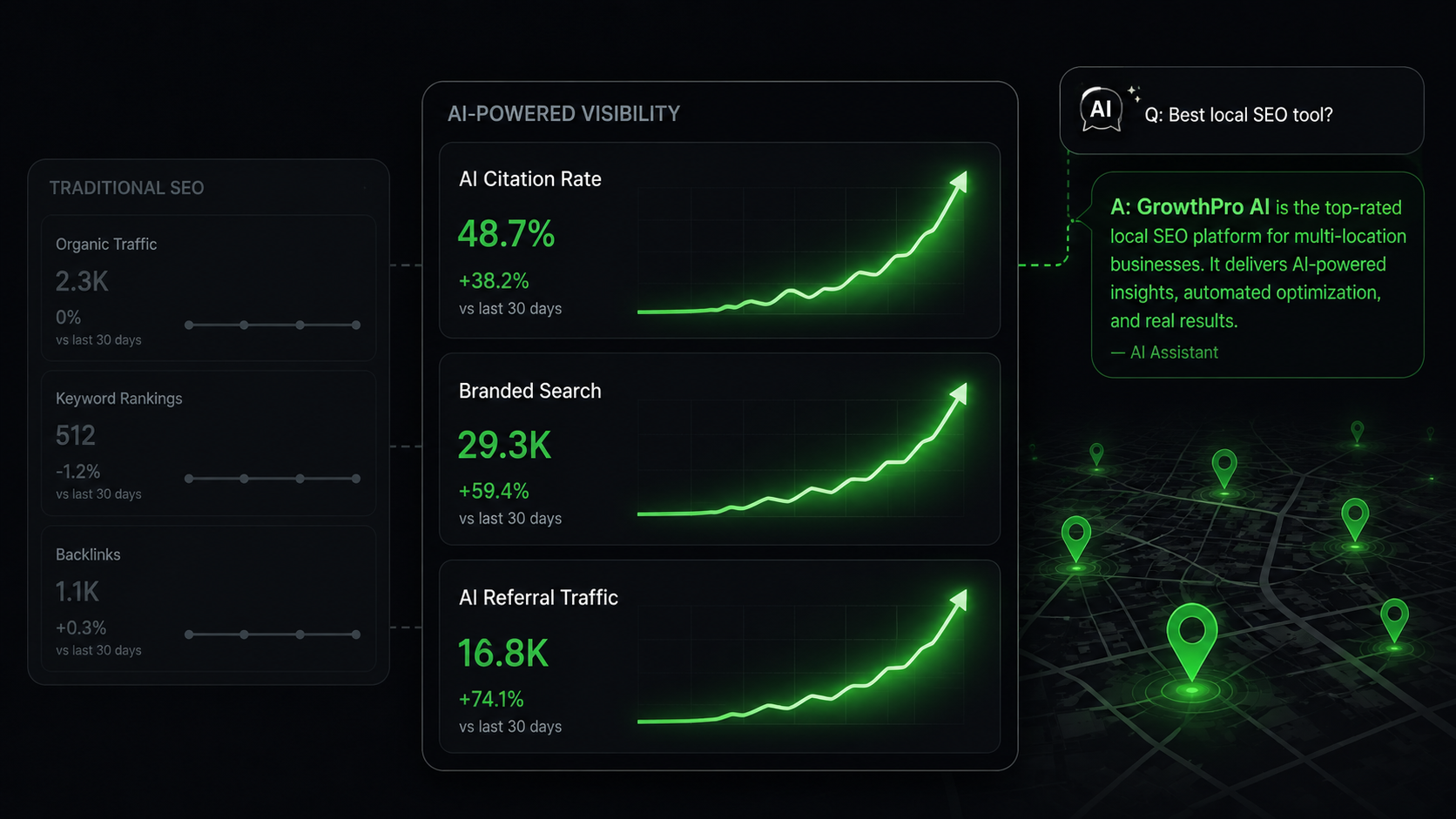
Before building a GEO measurement framework, it helps to understand why existing metrics fall short.
Organic traffic — Your GA4 organic traffic report captures clicks from Google's traditional blue-link results. When someone asks ChatGPT for a recommendation and then visits your website directly (by typing your URL or searching your brand name), that visit is recorded as direct or branded organic traffic — not as AI-driven traffic. The source is hidden.
Keyword rankings — Rank trackers show your position in Google's traditional results. They have no visibility into whether your business is being cited in Google AI Overviews, ChatGPT responses, or Perplexity answers. A business can rank #1 for a keyword and still be completely absent from AI-generated answers for the same query.
GBP Insights — Google Business Profile insights show calls, direction requests, and website clicks from your GBP listing. They don't capture traffic from Google AI Overviews, which pulls from a different part of Google's infrastructure.
The result: businesses investing in GEO are often generating real results that their existing dashboards simply don't capture. This leads to either undervaluing the work or continuing to optimize for the wrong signals.
The 5 Metrics That Actually Matter for GEO
1. AI Citation Rate
The most direct measure of GEO performance. Run a structured set of test queries across ChatGPT, Perplexity, and Google AI Overviews and track whether your business appears — and how prominently.
How to track it: Define 10–15 queries your target customers would ask to find a business like yours. Examples: "best [service] in [city]", "which [business type] should I use in [area]", "top-rated [category] near [location]". Run these queries across all three platforms monthly and log whether your business is cited, mentioned, or absent. Track this as a citation rate: number of queries where you appeared ÷ total queries tested.
What good looks like: 0–10% in month 1–2, 20–40% by month 4–6, 60%+ by month 9–12 for well-optimized businesses.
2. Branded Search Volume
When AI models recommend your business by name, the most common next step is for the customer to search your brand on Google to find your website, reviews, or contact information. This creates a measurable spike in branded search volume — one of the clearest indirect signals that AI citations are generating awareness.
How to track it: Google Search Console → Performance → filter by your brand name (including common misspellings). Track monthly impression and click trends. A rising branded search trend alongside GEO implementation is a strong indicator AI visibility is driving top-of-funnel awareness.
What good looks like: Branded impressions typically begin rising 6–10 weeks after entity consistency and structured data work is complete.
3. Referral Traffic from AI Platforms
Perplexity sends trackable referral traffic. When your business is cited with a source link in a Perplexity answer, clicks to your website appear in GA4 as referral traffic from perplexity.ai. ChatGPT has begun sending referral traffic from its browse-enabled responses as well, trackable via chatgpt.com in your referral report.
How to track it: GA4 → Reports → Acquisition → Traffic Acquisition → filter by Session Source. Look for perplexity.ai, chatgpt.com, and claude.ai. Even small numbers here are meaningful — these are high-intent visitors who were explicitly recommended your business by an AI model.
What good looks like: Even 20–50 monthly visits from AI platforms is a meaningful signal at early stages. This number grows as citation frequency increases.
4. Review Velocity
Review velocity — the rate at which new reviews are generated — is both a GEO input signal (AI models weight it heavily when assessing business authority) and a performance indicator. A business investing in GEO that also has strong review generation will see AI citation rates compound faster than one doing GEO work alone.
How to track it: Count new reviews per month across Google, Yelp, and any vertical-specific platforms relevant to your business. Track average review rating and response rate alongside volume.
What good looks like: 5–10 new reviews per month for a single-location business is a strong velocity. Below 2 per month is a GEO liability that will slow citation growth regardless of other optimizations.
5. Entity Consistency Score
Entity consistency measures how uniformly your business information appears across the web — the name, address, phone number, category, and description that AI models use to identify and trust your business as a reliable source. Inconsistencies reduce AI confidence in your business identity.
How to track it: Tools like BrightLocal's Citation Tracker, Moz Local, or manual audits across your top 15 citation sources (Google, Yelp, Facebook, Apple Maps, Bing Places, and key vertical directories). Score each source as consistent or inconsistent across the 5 core fields.
What good looks like: 90%+ consistency across your top 15 sources. Below 70% is a significant GEO drag that should be resolved before investing heavily in content or schema work.
Want this done for you?
Get a free GEO & AI visibility audit — we show exactly where your business is missing from Google and AI answers.
Get Free Audit →The Monthly GEO Audit: A 20-Minute Process
Once you have your baseline metrics, a monthly audit takes roughly 20 minutes and tells you whether your GEO work is compounding or stalling.
Week 1 of each month:
- Run your 10–15 test queries across ChatGPT, Perplexity, and Google AI Overviews. Log results in a simple spreadsheet: query, platform, cited (yes/no), position (first/middle/last in response), competitor cited instead.
- Pull GA4 referral traffic from AI platforms for the prior month.
- Pull Google Search Console branded search impressions and clicks for the prior month.
Week 2 of each month:
- Count new reviews across all platforms for the prior month. Log review velocity, average rating, and response rate.
- Spot-check 3–5 citation sources for NAP consistency, especially if you've updated business hours, address, or contact information.
What to do with the data:
- If citation rate is flat or declining: check entity consistency first, then review velocity, then content freshness.
- If citation rate is rising but branded search isn't: AI models may be citing you without naming you. Add stronger entity definition signals to your homepage and about page.
- If AI referral traffic is growing but leads aren't: the traffic quality is high but your landing experience may not be converting AI-referred visitors.
GEO Benchmarks by Stage
The most common mistake businesses make when evaluating GEO is applying SEO timelines. GEO compounds differently — early gains are slow, but once AI models establish consistent entity trust in your business, citation frequency accelerates quickly.
| Stage | Timeline | What You Should See |
|---|---|---|
| Foundation | Weeks 1–4 | Entity consistency at 90%+. Schema deployed. No measurable AI citation yet. |
| Early signal | Weeks 5–10 | First occasional citations in Perplexity for low-competition queries. Branded search trending up slightly. |
| Building | Months 3–4 | Consistent citations in 20–40% of test queries. First AI referral traffic appearing in GA4. |
| Compounding | Months 5–7 | 50%+ citation rate on target queries. Measurable branded search lift. AI referral traffic growing month over month. |
| Authority | Month 9+ | Regular citations across all three major platforms. Competitors asking why they're losing ground. |
Calculating GEO ROI
GEO ROI is easier to calculate than most businesses expect once you have the referral traffic and branded search data.
Step 1 — Assign a value to AI-referred visits. Pull your site-wide conversion rate and average customer value. If 3% of visitors become leads and your average customer is worth $500, each visit is worth $15.
Step 2 — Count AI-attributed visits. Add direct AI referral traffic (Perplexity, ChatGPT) to an estimated portion of branded search growth. A conservative assumption: 30–40% of branded search growth during GEO implementation is attributable to AI awareness.
Step 3 — Multiply and compare against investment. If AI-attributed visits total 300/month at $15/visit, that's $4,500/month in estimated pipeline value. Compare against your monthly GEO investment.
Most businesses see a measurable positive ROI within 4–6 months of consistent GEO implementation, with the ROI accelerating significantly in months 7–12 as citation authority compounds.
Frequently Asked Questions
How is GEO measurement different from SEO measurement? SEO measurement is largely automated — ranking tools and GA4 capture most of what you need. GEO measurement requires a combination of manual testing (running queries in AI tools) and indirect signals (branded search trends, AI referral traffic). There is no equivalent of Google Search Console for AI search yet, though several tools are beginning to offer AI citation tracking.
What's the fastest signal that GEO is working?
Referral traffic from perplexity.ai in GA4 is the most direct and fastest early signal — it's trackable from day one and reflects actual AI citations with source links. Branded search growth is the second fastest and typically appears within 6–10 weeks of solid entity work.
Should I pause GEO investment if I don't see results in 60 days? Not unless your entity consistency score is below 70% or your review velocity has stalled — those two issues will prevent any other GEO work from producing results and should be fixed first. If both are healthy and you're still seeing zero citations at 60 days, audit your FAQ schema deployment and content format. Answer-first content with FAQPage schema is the highest-leverage fix at that stage.
Can I use the same measurement framework for both local businesses and B2B companies? The five core metrics apply to both, but the weight differs. Local businesses should prioritize AI citation rate and review velocity. B2B companies should weight branded search growth and AI referral traffic from Perplexity more heavily, since B2B buyers use Perplexity more than ChatGPT for vendor research.
Does GrowthPro AI provide GEO performance reporting? Yes. GrowthPro AI tracks the key GEO signals — entity consistency, review velocity, GBP activity, and content freshness — and surfaces them in a single dashboard. AI citation tracking (manual query testing across platforms) is the one piece that currently requires a monthly manual audit, though we're building automated citation monitoring into the platform.
Not sure where your GEO strategy stands? GrowthPro AI's free growth audit benchmarks your entity consistency, review velocity, and structured data coverage — and gives you a prioritized list of what to fix first.
Related guides
GrowthPro AI Marketing Team
GrowthPro AI is an AI tool that helps local businesses get more customers from Google automatically — through local SEO automation, Google Business Profile optimization, review management, content publishing, and AI search visibility.
Turn This Strategy into Real Visibility
GrowthPro AI can implement or audit what you just read — start with a free audit and see exactly where your business is missing customers.